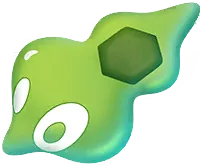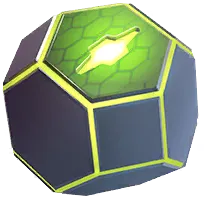

Overview
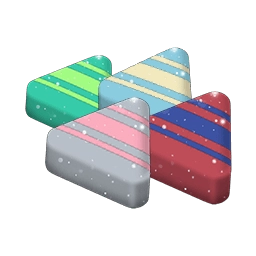
Candy is a family-specific resource used to evolve Pokémon, power them up, unlock a second Charged Attack, purify Shadow Pokémon, train Max Moves, activate Adventure Effects, and fuse or change the form of eligible species. It belongs to an evolution family rather than one individual Pokémon: catching, hatching, transferring, trading, and walking a Buddy all add to that family’s shared Candy balance. Regional forms also share their family’s Candy, even when their evolution paths or requirements differ.
How to get it
Catch, hatch, transfer (to Professor Willow or Pokémon HOME), or trade eligible Pokémon from the family.
Walk with a Buddy, convert Rare Candy into that family’s Candy, leave a Pokémon at a Power Spot after a Max Battle, or earn it from Research and feeding Berries to Gym defenders.
How to use it
Open a Pokémon’s details to see the family’s balance and the cost of the desired action.
Spend the matching family Candy; another species’ Candy cannot substitute for it.
Worth knowing
Pinap Berries and Silver Pinap Berries increase catch Candy when the berried throw catches the Pokémon, making them useful when saving Candy to evolve or power up a species.
Evolving a Pokémon does not reroll its IVs. Choose the individual first, particularly for expensive branches.
A family’s balance survives changes to your collection
You keep a family’s Candy even after transferring every Pokémon from that family. Research can also award Candy for a family you have not yet registered in the Pokédex; receiving the Candy itself does not register the Pokémon.
Trading gives 1, 2, or 3 Candy for the Pokémon you send away depending on the distance between the two Pokémon’s catch locations (under 10 km, 10 to 100 km, or over 100 km). Evolving a Pokémon normally returns 1 Candy after charging the upfront evolution cost (typically 12, 25, 50, 100, or 400 Candy depending on the species). For a standard 25-Candy evolution, you must have all 25 Candy before you can evolve, even though the net cost afterward is 24 Candy.
Trading can remove the evolution Candy cost for certain eligible species, but it also rerolls IVs. Decide whether you want the cheaper evolution or to preserve a particular individual’s existing stats.
Catch bonuses and Buddy Candy
Ordinary catches award 3 Candy for a base-stage Pokémon, 5 for a first-stage evolution, and 10 for a second-stage evolution. Feeding a Pinap Berry doubles those amounts to 6, 10, and 20 Candy if that throw catches the Pokémon, while a Silver Pinap Berry multiplies the base catch Candy by roughly 2.333× (yielding 7, 11, and 23 Candy before other bonuses). Event multipliers and active Mega Evolutions or Primal Reversions can increase catch Candy further.
For example, Bulbasaur, Ivysaur, and Venusaur all use Bulbasaur Candy. Spending Candy on one reduces the balance available to the others. Candy itself does not occupy Item Bag slots, and having more of it does not change a Pokémon’s IVs.
Buddy Candy distance depends on the species, with standard distance tiers of 1, 3, 5, and 20 km. Getting your Buddy Excited halves the required walking distance while the effect remains active, and walking along Routes with your Buddy also reduces the distance needed.
Beyond walking, transferring a Pokémon to Professor Willow or Pokémon HOME awards 1 Candy, leaving a Pokémon at a Power Spot after a Max Battle can earn up to 5 Candy based on the battles it assists, and feeding Berries to friendly Gym defenders has a small chance to award 1 Candy for that defender’s family.
Candy does not replace every evolution requirement
Many evolutions require an Evolution item, a specific time of day, a Lure Module, or a completed Buddy task alongside Candy, while Gimmighoul evolves using 999 Gimmighoul Coins instead of Candy.
Beyond evolution and standard power-ups, unlocking a second Charged Attack costs 25, 50, 75, or 100 Candy plus Stardust depending on the species.
Purifying a Shadow Pokémon costs 1, 3, 5, or 20 Candy and reduces future power-up, evolution, and second Charged Attack Candy costs by 10%, whereas Shadow Pokémon pay 1.2× the usual Candy for power-ups and second Charged Attacks.
Candy is also spent alongside Max Particles to unlock and level up Max Moves (Levels 1 and 2), alongside Stardust to activate Adventure Effects or change certain forms, and alongside Fusion Energy for both participating Pokémon when fusing species such as Necrozma or Kyurem.
Finally, Candy XL is a separate resource: you can convert 100 ordinary Candy into 1 Candy XL of the same family, and that conversion cannot be reversed.
Sources & further reading
goldandappelpub.com
niantic.helpshift.com
- https://niantic.helpshift.com/hc/en/6-pokemon-go/faq/2372-powering-up-pokemon/
- https://niantic.helpshift.com/hc/en/6-pokemon-go/faq/2389-transferring-pokemon/
- https://niantic.helpshift.com/hc/en/6-pokemon-go/faq/4798-max-battles-and-catching-max-pokemon-1729887131/
- https://niantic.helpshift.com/hc/en/6-pokemon-go/faq/122-glossary/?l=fr&title=niantic.helpshift.com
- https://niantic.helpshift.com/hc/en/6-pokemon-go/faq/100-evolving-your-pokemon/
- https://niantic.helpshift.com/hc/en/6-pokemon-go/faq/1011-fast-attacks-charged-attacks/?hl=pt
- https://niantic.helpshift.com/hc/en/6-pokemon-go/faq/2396-shadow-pokemon-purified-pokemon/
- https://niantic.helpshift.com/hc/en/6-pokemon-go/faq/4797-collecting-max-particles-and-dynamaxing-or-gigantamaxing-pokemon-1729887059/
- https://niantic.helpshift.com/hc/en/6-pokemon-go/faq/4386-what-are-adventure-effects/
- https://niantic.helpshift.com/hc/en/6-pokemon-go/faq/4736-what-is-pokemon-fusion/?p=.
- https://niantic.helpshift.com/hc/en/6-pokemon-go/faq/96-trading-pokemon/
- https://niantic.helpshift.com/hc/en/6-pokemon-go/faq/2155-buddy-adventure/?l=fr&title=niantic.helpshift.com